Receiving a low AMH result at a young age can feel unsettling, especially if you are not planning a pregnancy soon. But one test result cannot explain your entire fertility picture. AMH should be interpreted alongside age, medical history, menstrual cycles, ultrasound findings, and your plans for having children.
This article explains what low AMH can mean, which assessments may be helpful, and what you can discuss with your doctor. For an introduction to the test, learn more about theAMH test.
What Does Low AMH Mean?
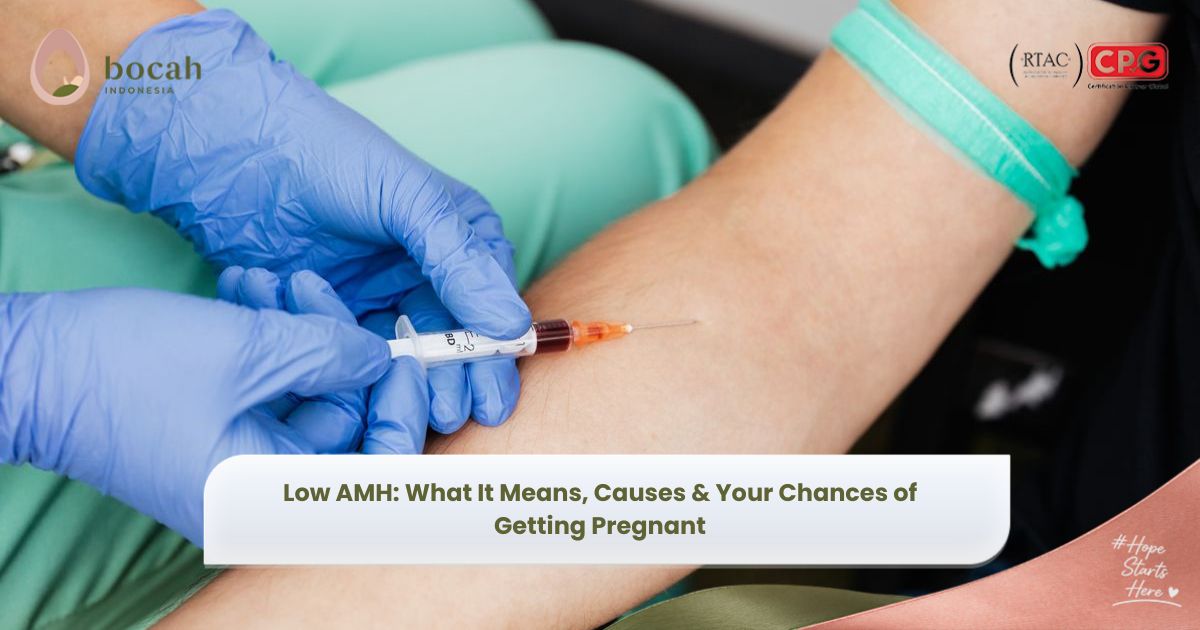
AMH, or anti-Müllerian hormone, is produced by small follicles in the ovaries. An AMH test is mainly used to estimate ovarian reserve—the number of eggs remaining in the ovaries.
A low AMH result may suggest a lower-than-expected ovarian reserve for a particular age group. However, AMH does not measure egg quality or predict whether someone can or cannot conceive naturally on its own.
Age remains one of the most important factors affecting pregnancy chances and egg quality. At a young age, a low AMH result does not automatically mean that you will have difficulty conceiving now or in the future.
Mulai Promil Sekarang
Why Can AMH Be Low at a Young Age?
AMH levels vary from person to person. For some women, a lower result may reflect normal biological variation. A doctor may also consider conditions or experiences associated with reduced ovarian reserve.
A history of ovarian surgery or treatment for ovarian cysts.
Endometriosis or another condition affecting the ovaries.
Previous chemotherapy or radiotherapy.
A family history of early menopause or primary ovarian insufficiency.
Medical conditions, smoking, or other factors relevant to your personal history.
What Should Be Evaluated?
A doctor should not draw conclusions about fertility from one AMH value alone. A complete evaluation can clarify whether the result needs monitoring, whether there are modifiable risk factors, and which next steps fit your reproductive plans.
Area to Evaluate
Purpose
Age and conception history
Put fertility potential and reproductive plans into context.
Menstrual cycle and symptoms
Identify possible ovulation or hormonal concerns.
Ultrasound and antral follicle count (AFC)
Add to the overall picture of ovarian reserve.
Medical and family history
Identify risk factors for reduced ovarian reserve.
Family-building plans
Help decide whether monitoring or fertility preservation should be discussed.
1. Menstrual Cycles and Ovulation Signs
Regular periods can be one sign that ovulation is still occurring, but they do not necessarily reflect the number of eggs remaining. Your doctor may ask about cycle patterns, changes in bleeding, pelvic pain, and other relevant symptoms.
2. Transvaginal Ultrasound and Antral Follicle Count
A transvaginal ultrasound can assess the ovaries and count antral follicles. Antral follicle count (AFC) and AMH are often reviewed together to estimate how the ovaries may respond to stimulation in fertility treatment.
3. Hormone Tests or Other Assessments When Needed
Depending on your circumstances, your doctor may suggest other hormone tests or additional assessments. The purpose is not simply to find a normal number, but to identify possible causes that may need attention.
4. Medical and Family History
A history of ovarian surgery, endometriosis, cancer treatment, or family members with early menopause can help your doctor assess risk more accurately.
Does Low AMH Mean It Will Be Hard to Get Pregnant?
Not necessarily. AMH is more useful for estimating the number of eggs that may be retrieved after ovarian stimulation than for predicting natural conception. Women with low AMH can still become pregnant, especially at a younger age and when no other fertility factors are present.
Likewise, a normal or high AMH result is not a guarantee of pregnancy. Fertility is influenced by many factors, including ovulation, fallopian tubes, uterine health, a partner’s sperm, age, and overall health.
Options That May Be Considered
The next step should always be individualized. If you are not ready to become pregnant but have risk factors for declining ovarian reserve, your doctor may discuss monitoring or fertility-preservation options.
One option that may be discussed isegg freezing. It is not necessary for everyone with low AMH and should be considered in the context of age, other test results, family-building plans, and personal preferences.
If you are already trying to conceive and other factors are affecting your chances, your doctor may discuss treatment options, includingin vitro fertilization (IVF), when appropriate.
When Should You See a Fertility Specialist?
Consider a consultation if low AMH occurs alongside irregular periods, a history of ovarian surgery, endometriosis, cancer treatment, or a family history of early menopause. You may also wish to speak with a specialist sooner if you are delaying pregnancy and want to discuss fertility-preservation options.
If you have been trying to conceive for 12 months without pregnancy when you are under 35, or for 6 months when you are 35 or older, consider afertility evaluation. Afertility specialist can assess all aspects of fertility not AMH alone.
Frequently Asked Questions (FAQ)
Does low AMH at a young age mean menopause will happen earlier?
Not necessarily. AMH cannot precisely predict when an individual will reach menopause. The result needs to be considered alongside your medical history and other assessments.
Can low AMH be increased?
There is currently no proven way to significantly increase ovarian reserve. The focus is on understanding your situation, supporting overall health, and discussing realistic reproductive plans with your doctor.
Does low AMH mean I need IVF right away?
No. Fertility treatment is not decided by AMH alone. Your doctor will also consider age, duration of trying to conceive, ovulation, the condition of the tubes and uterus, and your partner’s sperm factors.
Should I repeat the AMH test?
Your doctor may consider repeating the test or using complementary tests when the result does not match the broader clinical picture. This decision depends on the purpose of testing and your circumstances.
Conclusion
Low AMH at a young age should be assessed calmly and in context. The result can help you plan your next steps, but it is not a verdict that you cannot become pregnant. Discuss your AMH result with a doctor so that your decisions align with your health and family-building goals.
For a consultation about low AMH and fertility-planning options, the Bocah Indonesia team is ready to help. If IVF is appropriate, you can also reviewIVF costs.
Reference
Practice Committee of the American Society for Reproductive Medicine. Testing and interpreting measures of ovarian reserve: a committee opinion. Fertility and Sterility. 2020;114(6):1151–1157.https://doi.org/10.1016/j.fertnstert.2020.09.134