When fertility test results show low AMH, many women worry immediately. It is understandable — AMH is often called a marker of the egg reserve. But before panicking, it helps to understand whatAMH testing really measures and what a low result does — and does not — mean.
This article explains what AMH is, what low AMH means, its causes, and your realistic chances of getting pregnant — naturally or through IVF.
What Is AMH (Anti-Müllerian Hormone)?
AMH, or Anti-Müllerian Hormone, is produced by the small follicles in the ovaries. The level of AMH in the blood is used to estimate how many eggs (ovarian reserve) a woman still has.
The more active small follicles a woman has, the higher her AMH. Conversely, fewer remaining follicles means lower AMH. This is why AMH is one of the key tests before starting a fertility treatment.
What Does Low AMH Mean?
Low AMH generally indicates a diminished ovarian reserve — meaning feweregg cells remain compared with women of the same age.
Mulai Promil Sekarang
There is one important point that is often misunderstood: AMH reflects the QUANTITY of eggs, not their QUALITY. A woman with low AMH can still have good-quality eggs.
AMH Reference Ranges (General Guide)
AMH Level (ng/mL)
General Interpretation
> 3.5
High (often associated with PCOS)
1.0 – 3.5
Normal
0.7 – 1.0
Slightly low (still within reason, depending on age)
0.3 – 0.7
Low (declining egg reserve)
< 0.3
Very low
Note: normal values are relative to age and laboratory method. Interpretation should always be done by a doctor.
Keep in mind that AMH reference values are relative to age and the laboratory method used, so results should always be interpreted by a doctor. To learn about what is typical, read aboutnormal egg cell count.
Low AMH vs Egg Quality
Low AMH does not automatically mean poor egg quality. It mainly tells you that time may be more limited — which is a reason to act, not to lose hope.
Causes of Low AMH
Age (Natural Decline)
The most common cause is age. The egg reserve naturally declines from birth, and the decline speeds up from the mid-30s. To understand the effect of age, read abouthow age affects egg quality.
Medical Conditions & Treatments
Endometriosis, especially when it involves the ovaries (endometrioma).
Ovarian surgery, such as removal of ovarian cysts.
Chemotherapy or radiotherapy that affects ovarian function.
Autoimmune diseases.
Primary ovarian insufficiency (early menopause).
Genetics
Some women naturally have a smaller egg reserve from birth. This is one reason AMH testing is recommended for women planning pregnancy — including those consideringegg freezing to delay childbearing.
Can You Still Get Pregnant with Low AMH?
The short answer is yes. Low AMH is not a verdict that you cannot get pregnant. It simply means you should be more proactive — and, if needed, see a fertility doctor sooner rather than later.
Natural Conception
As long as ovulation is still occurring regularly, natural conception remains possible — although the window of time may be shorter. If AMH is low, do not delay your pregnancy plans.
IVF and Low AMH
In anin vitro fertilization (IVF) program, low AMH usually means fewer eggs will be retrieved during stimulation. However, IVF actually helps: your doctor can tailor the stimulation protocol — includingovulation induction — so that the available eggs develop optimally.
Quality matters more than quantity: even a single good-quality egg can lead to a successful pregnancy.
How Is AMH Tested?
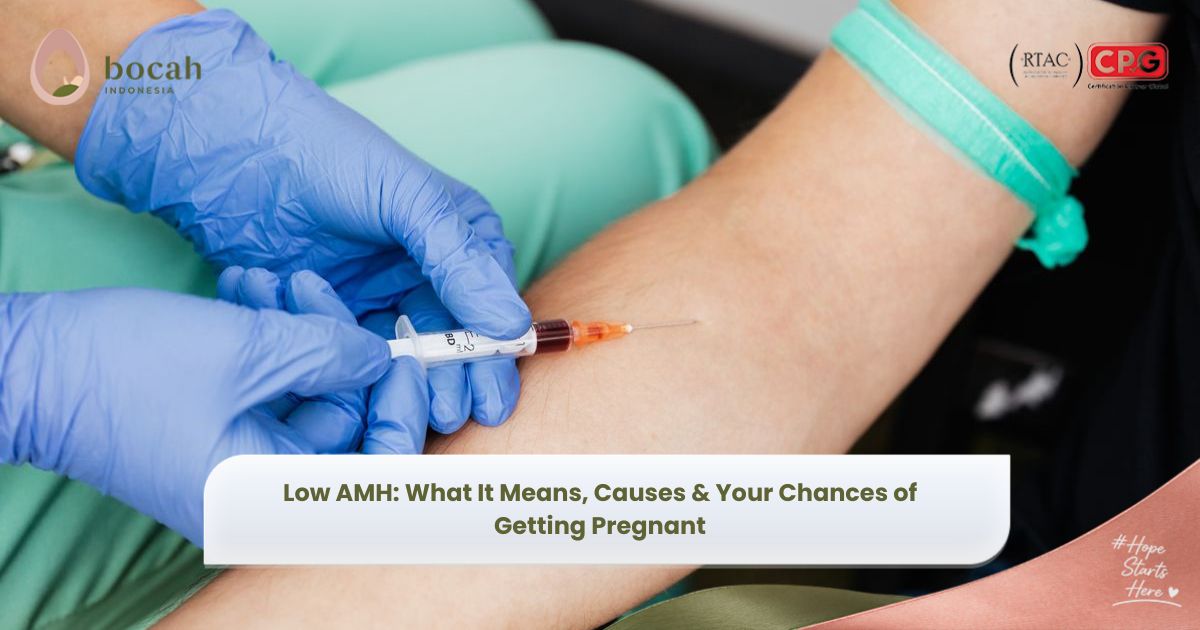
AMH is measured with a simple blood test. One advantage is that it can be done on any day of the menstrual cycle — unlike FSH, which must be tested on day 2–3 of the period. For more detail on the procedure and preparation, read our article onAMH testing.
Can AMH Levels Be Increased?
To be honest: so far, no treatment has been proven to add new eggs or significantly raise AMH. AMH reflects the reserve you already have.
What you CAN do is keep the eggs you have in the best condition — through a healthy lifestyle, adequate vitamin D (if you are deficient), stress management, and avoiding harmful habits. The focus should be onboosting egg quality rather than chasing a higher number.
When to See a Fertility Doctor
If your AMH result is low, it is wise to consult a fertility doctor soon — especially if you are planning a pregnancy or have been trying for more than 6–12 months (depending on age). The doctor will combine your AMH result with other tests to plan the best next step, starting with a comprehensivefertility testing workup.
At Bocah Indonesia — a fertility clinic in Jakarta and Tangerang — ourfertility doctors will guide you through every step with a personalized approach, from evaluation to the treatment that best fits your condition.
Is low AMH the same as early menopause?
Not necessarily. Low AMH means the egg reserve is declining, while menopause means periods have stopped. Women with low AMH usually still menstruate and ovulate, so pregnancy remains possible.
Does low AMH mean poor egg quality?
No. AMH reflects the quantity of eggs, not their quality. The eggs a woman with low AMH still has can be perfectly healthy.
Can I conceive naturally with very low AMH?
As long as ovulation still occurs, natural conception is possible, though the window may be shorter and the odds lower. Consulting a doctor early is highly recommended.
Is IVF more recommended when AMH is low?
Often, yes — IVF allows doctors to monitor and optimize the available eggs directly. However, the decision is always tailored to each couple’s condition.
Conclusion
Low AMH is a signal that your egg reserve is declining — not the end of your chances of having a baby. With the right understanding and proactive action, many women with low AMH go on to conceive, naturally or through IVF.
If you would like to discuss your AMH result or start anin vitro fertilization (IVF) program at Bocah Indonesia, our fertility doctors are ready to help. You can also reviewIVF costs or contact us for an initial consultation.
Source
Broer SL, Broekmans FJ, Laven JS, Fauser BC. Anti-Müllerian hormone: ovarian reserve testing and its potential clinical implications. Human Reproduction Update. 2014;20(5):688–701.doi.org/10.1093/humupd/dmu020
Tal R, Seifer DB. Ovarian reserve testing: a user’s guide. American Journal of Obstetrics and Gynecology. 2017;217(2):129–140.doi.org/10.1016/j.ajog.2017.02.027
Steiner AZ, Pritchard D, Stanczyk FZ, et al. Association between biomarkers of ovarian reserve and infertility among older women of reproductive age. JAMA. 2017;318(14):1367–1376.doi.org/10.1001/jama.2017.14588
La Marca A, Sunkara SK. Individualization of controlled ovarian stimulation in IVF using ovarian reserve markers: from theory to practice. Human Reproduction Update. 2014;20(1):113–130.doi.org/10.1093/humupd/dmt037
Centers for Disease Control and Prevention (CDC). Assisted Reproductive Technology (ART).cdc.gov/art