For parents-to-be undergoingin vitro fertilization (IVF), the term “blastocyst” often comes up when the doctor discusses embryo culture results. But what exactly is a blastocyst, and why is this stage so important to the success of the treatment?
In short, a blastocyst is an embryo at day 5–6 after fertilization. At this stage, the embryo has a more complex structure and is considered most ready to implant in the uterine lining. That is why blastocyst transfer is a strategy widely used by fertility clinics to improve the chance of pregnancy.
This article explains what a blastocyst is, how its quality is assessed, and how it contributes to IVF success.
What Is a Blastocyst?
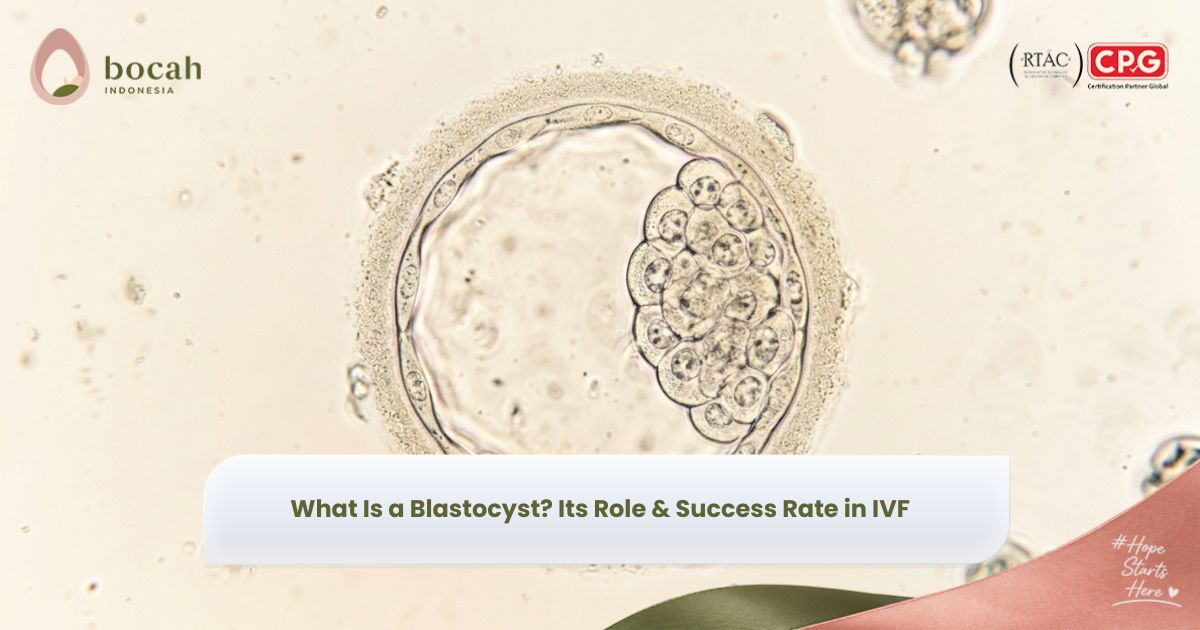
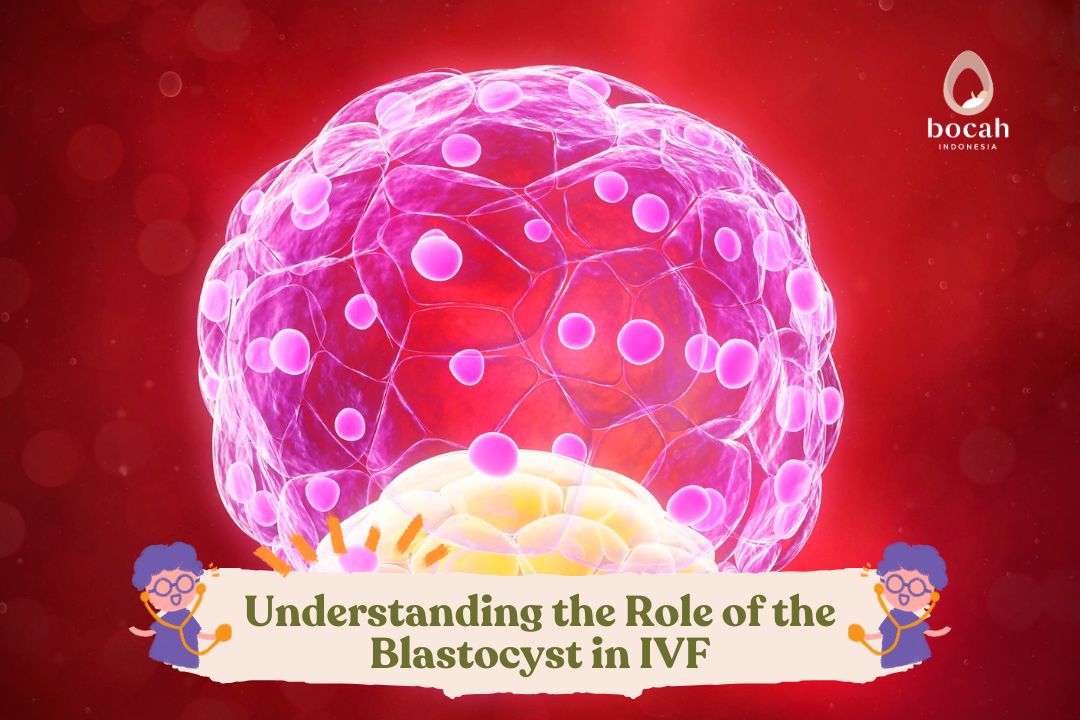
A blastocyst is an embryo that has developed to day 5 or day 6 after fertilization. At this point, it is no longer just a cluster of cells — it has formed a fluid-filled cavity and two distinct groups of cells with different roles.
Blastocyst formation begins with a single fertilizedegg cell. To understand where it fits, it helps to know the stages of embryo development in order.
Mulai Promil Sekarang
Day
Stage
Key Feature
Day 1
Zygote
The fertilized egg begins dividing
Day 2–3
Cleavage-stage embryo
2–8 cells (blastomeres)
Day 4
Morula
Around 16–32 cells compacting
Day 5–6
Blastocyst
Fluid-filled cavity (blastocoel), inner cell mass, and trophectoderm
After the blastocyst stage, the embryo continues into the gastrulation stage. However, in IVF, the blastocyst stage is the critical point — this is when embryos are most commonly transferred to the uterus.
Blastocyst Structure: Inner Cell Mass, Trophectoderm, and Blastocoel
A blastocyst has three main components:
Inner cell mass (ICM): the group of cells that will develop into the fetus.
Trophectoderm: the outer cell layer that will form the placenta.
Blastocoel: the fluid-filled cavity inside the blastocyst.
These three components are the basis for how embryologists grade a blastocyst before deciding which embryo to transfer.
Why Is the Blastocyst Stage Important in IVF?
More Accurate Embryo Selection
Not every embryo can survive to the blastocyst stage. Embryos that reach day 5–6 generally have better developmental potential. By allowing embryos to grow to this stage, embryologists can select the best-quality embryo for transfer.
Better Timing with the Uterus
In natural conception, the embryo reaches the uterus at the blastocyst stage. Blastocyst transfer mimics this timing, aligning better with the uterine implantation window — which is whyembryo implantation is more likely to succeed.
Lower Risk of Multiple Pregnancy
Because blastocysts are already well selected, transferring a single good-quality blastocyst is often enough — reducing the risk of multiple pregnancy that is associated with transferring more than one embryo.
Embryo quality is also largely determined byegg and sperm quality before the program begins.
Day-3 Embryo Transfer vs Blastocyst Transfer (Day 5–6)
Aspect
Day-3 Embryo Transfer
Blastocyst Transfer (Day 5–6)
Embryo age
3 days
5–6 days
Structure
6–8 cells (cleavage)
Cavity + inner cell mass + trophectoderm
Selection basis
Cleavage speed & pattern
More complex structural development
Implantation potential per embryo
Lower
Higher
Risk of no embryo available for transfer
Lower
Higher (in some cases)
The choice between day-3 and blastocyst transfer depends on the number and quality of embryos, previous treatment history, and your fertility doctor’s recommendation.
How Is Blastocyst Quality Assessed?
Blastocyst quality is generally assessed using the Gardner grading system, which looks at three aspects: expansion stage, inner cell mass quality, and trophectoderm quality.
Number (1–6): blastocyst expansion. 1 = early cavity, 4 = fully expanded, 5 = hatching, 6 = fully hatched.
First letter (A/B/C): inner cell mass quality. A = excellent, C = poor.
Second letter (A/B/C): trophectoderm quality. A = excellent, C = poor.
For example, a grade “4AA” blastocyst is fully expanded with excellent inner cell mass and trophectoderm — a strong sign of implantation potential.
Blastocyst Transfer Success
In general, blastocyst transfer offers a higher implantation rate per embryo than day-2 or day-3 transfer. However, success varies from couple to couple and depends on the mother’s age, embryo quality, and uterine conditions.
Good-quality blastocysts that are not transferred immediately can be frozen through vitrification for a later cycle. Frozen blastocyst transfer (FET) offers competitive success rates and more flexibility.
Freezing also allows parents-to-be to wait for the optimal uterine condition, or to runPGT-A genetic testing on the embryo before transfer. To understand the options better, read about the difference between egg freezing andembryo freezing.
Who Is a Good Candidate for Blastocyst Transfer?
Blastocyst transfer is generally recommended for couples who have several good-quality embryos. In some cases — for example, when very few embryos are available — a day-3 transfer may be considered so the embryos are not at risk of failing to develop outside the womb.
At Bocah Indonesia — a fertility clinic in Jakarta and Tangerang — embryos are cultured in an internationally accredited (RTAC) embryology laboratory built to Australian standards, and every transfer is guided by an experienced team offertility doctors.
Frequently Asked Questions (FAQ)
What is the difference between a blastocyst and an embryo?
A blastocyst is an embryo — specifically, an embryo at a more advanced stage (day 5–6). The term “embryo” covers all stages from fertilization onward; the blastocyst is one specific stage.
Can all embryos develop into blastocysts?
No. Some embryos stop developing before reaching the blastocyst stage. This is why growing embryos to the blastocyst stage also acts as a natural selection process for the most viable embryos.
How successful is blastocyst transfer?
Success rates vary by age, embryo quality, and other factors. In general, blastocysts have a higher implantation potential per embryo than day-3 embryos.
Is a frozen blastocyst as good as a fresh one?
Yes. With modern vitrification technology, the survival and success rates of frozen blastocysts are highly competitive and often comparable to fresh transfer.
Source
Glujovsky D, Quinteiro Retamar AM, Alvarez Sedo CR, Ciapponi A, Cornelisse S, Blake D. Cleavage-stage versus blastocyst-stage embryo transfer in assisted reproductive technology. Cochrane Database of Systematic Reviews. 2022.doi.org/10.1002/14651858.CD002118.pub6
Alpha Scientists in Reproductive Medicine and ESHRE Special Interest Group of Embryology. The Istanbul consensus workshop on embryo assessment: proceedings of an expert meeting. Human Reproduction. 2011;26(6):1270–1283.doi.org/10.1093/humrep/der037
Gardner DK, Schoolcraft WB. In vitro culture of human blastocysts. In: Jansen R, Mortimer D, eds. Towards Reproductive Certainty: Fertility and Genetics Beyond 1999. Parthenon Press; 1999:378–388. (Book chapter — no online link)
Zegers-Hochschild F, Adamson GD, Dyer S, et al. The International Glossary on Infertility and Fertility Care, 2017. Fertility and Sterility. 2017;108(3):393–406.doi.org/10.1016/j.fertnstert.2017.06.005
Wong KM, van Wely M, Mol F, Repping S, Mastenbroek S. Fresh versus frozen embryo transfers in assisted reproduction. Cochrane Database of Systematic Reviews. 2017;3(3):CD011184.doi.org/10.1002/14651858.CD011184.pub2
Centers for Disease Control and Prevention (CDC). Assisted Reproductive Technology (ART).cdc.gov/art